

Introduction:
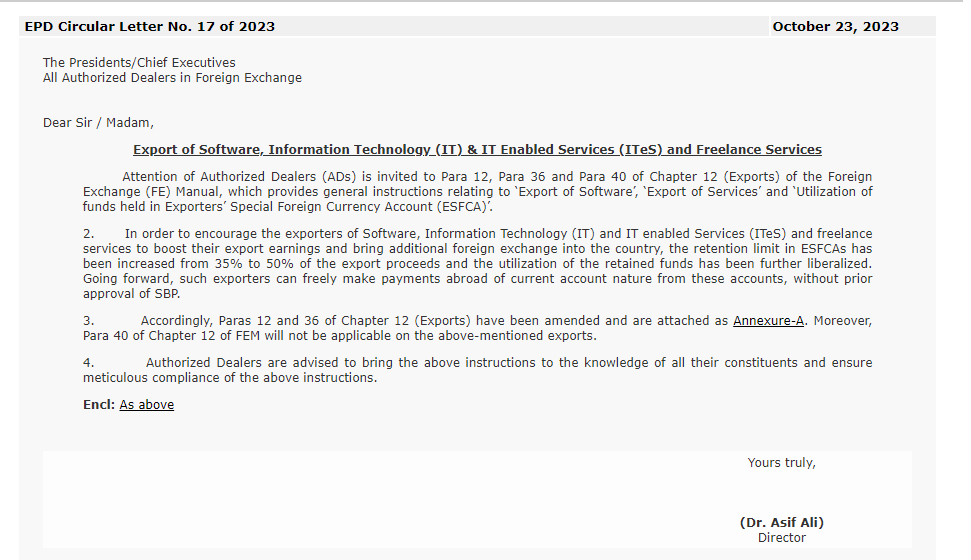
In a globalized world where technological advancements are transforming economies, Pakistan recognizes the pivotal role of its software, information technology (IT), and IT-enabled services (ITeS) sector in contributing to economic growth. To further encourage and support exporters in these domains, the country has undertaken significant policy changes. One such notable alteration involves the enhancement of the retention limit in Exchange Special Foreign Currency Accounts (ESFCAs) from 35% to 50% of export proceeds. Additionally, the utilization of retained funds has been liberalized, allowing exporters more flexibility. Importantly, exporters are now empowered to make payments abroad for current account transactions without the prior approval of the State Bank of Pakistan (SBP).
Retention Limit Increase:
The decision to increase the retention limit from 35% to 50% underscores the government’s commitment to fostering the growth of the software, IT, and ITeS sectors. This adjustment enables exporters to retain a larger portion of their export earnings, providing them with increased financial flexibility to reinvest in their businesses, fuel innovation, and expand their global footprint.
Liberalized Utilization of Retained Funds:
In addition to the expanded retention limit, the liberalization of fund utilization is a strategic move to empower exporters further. The relaxed rules on the use of retained funds afford exporters greater autonomy in managing their finances. This flexibility is crucial for companies and freelancers in the software and IT sectors, allowing them to strategically allocate funds for research and development, skill development, and the acquisition of cutting-edge technologies.
Free Payments Abroad for Current Account Transactions:
One of the most significant policy shifts is the elimination of the requirement for prior approval from the State Bank of Pakistan for making payments abroad for current account transactions. This streamlining of the process is a bold step towards reducing bureaucratic hurdles, facilitating smoother business operations for exporters in the designated sectors.
Benefits to Exporters:
- Financial Flexibility: The increased retention limit provides exporters with more financial freedom to manage their cash flow efficiently. This is particularly beneficial for startups and small enterprises seeking to reinvest in their businesses.
- Innovation and Expansion: The liberalized utilization of retained funds encourages innovation and expansion initiatives. Exporters can channel resources into research and development, training programs, and market exploration, enhancing their competitiveness on the global stage.
- Operational Efficiency: The elimination of the need for prior approval from the State Bank of Pakistan for current account transactions simplifies financial operations for exporters. This reduction in bureaucratic processes contributes to improved efficiency in business transactions.
- Global Competitiveness: By supporting exporters in the software, IT, and ITeS sectors, Pakistan aims to enhance the global competitiveness of its technology-driven industries. This, in turn, can attract foreign investment and collaborations, fostering economic growth.
Conclusion:
Pakistan’s decision to boost the software, IT, and ITeS sectors by liberalizing policies related to ESFCAs reflects a forward-thinking approach to economic development. By empowering exporters with increased retention limits, flexible fund utilization, and simplified transaction processes, the government aims to create an environment conducive to innovation, growth, and increased foreign exchange earnings. These policy changes signal a commitment to positioning Pakistan as a competitive player in the global technology landscape, contributing significantly to the country’s economic prosperity.